Machine Learning
Super Mario with Deep Reinforcement Learning
An RL project for Super Mario Bros: all 32 levels solved, the game finished end to end (Double DQN + PPO), with Go-Explore, behavior cloning and transfer learning – and five metrics that measured something other than what was meant.
What it’s about
An RL project built from scratch: an agent learns to play the NES version of Super Mario Bros purely from the pixels of the game screen. Nobody tells it how to play – only that going right is good and dying is bad. Around it sits the full tooling so the training runs reproducibly and the result is showable in the browser.
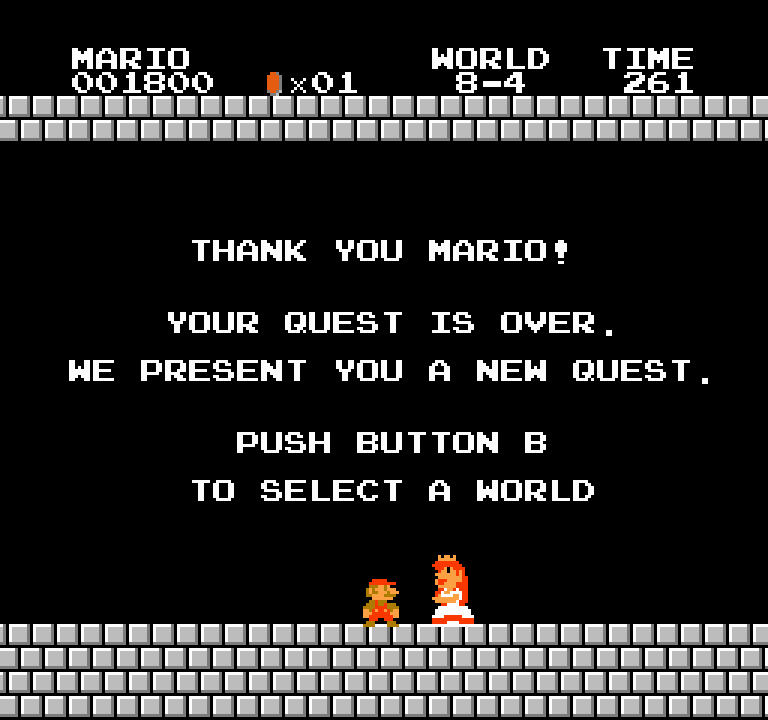
Result: Super Mario Bros finished end to end – 32 of 32 levels solved
Every level meets the same, up-front success criterion: 20 of 20 greedy episodes reaching the flag.
- Level 1-1 via a hand-implemented Double DQN (online/target network, experience replay, epsilon-greedy)
- All remaining 31 levels via PPO (Stable-Baselines3) – the standard pipeline built up along the way (VecNormalize, LR decay, 16 parallel envs) solves a new level in ~40 minutes of training
- For the spots where pure RL failed, a dedicated tool each: Go-Explore savestate search (the trampoline tower in 2-1, the labyrinths in 4-4 and 7-4, World 8), behavior cloning and transfer learning between structurally identical levels (5-3)
- All 32 trained models published as releases (v1.0 through v1.3)
The honest caveat: the environment is deterministic under greedy play. “20/20” means reliably reproducible, not robust to perturbation.
Try it yourself
The through-line: five metrics that measured something other than what was meant
The project’s real subject only surfaced while building it – and it ran underneath every hard level:
- Loop farming (4-4): wrong paths throw Mario back, and large x-position jumps backwards cost no reward – so the agent ran in circles forever: 13,824 reward at a 0% flag rate. Fix: a
ProgressRewardwrapper that only rewards new x-maxima. - 16-bit overflow (4-4): next, the agent farmed an emulator glitch where
x_posbriefly jumps to 65535 on screen transitions – 57k reward for an integer overflow. Fix: only count physically plausible steps. - Dead candidates (5-3): this time it wasn’t the agent but my own search code. During a fall
x_poskeeps climbing because Mario drifts forward – so a deeper fall beat any safe landing, and the search reported a “breakthrough” for a candidate that was dead. - Maximum instead of end position (7-4): Go-Explore scored candidates by the furthest point reached – in a loop level, an excursion that ended in a throw-back therefore counted as success.
- A blind instrument (8-4): in the loop section
x_possimply keeps counting while running in circles – reward,ProgressRewardand the Go-Explore criterion all lied at once. My replacement signal was just as blind: I searched 40,000 candidates with the wrong RAM byte ($0760instead of$074E).
Every fix was measured against the exploiting model up front, before investing new compute (13,824 → 1,574 and 64,735 → 221 respectively). The common denominator: the agent optimizes exactly what is measured – never what was meant. The same gap costs a level here; in real systems it’s called the alignment problem.
The most instructive stretches
- 5-3: transfer beats search. The agent froze at exactly x 783 – the same spot where 1-3 had failed, because Nintendo built both treetop levels from the same block. Four approaches failed (6M steps, entropy boost, 32,000 Go-Explore candidates, 168 scripted jump variants). Then the 1-3 model was simply let loose on 5-3: x 1606 on the first try, fine-tuning, 20/20. In 6-3 the same trick was tested and discarded – a similar level type is not a twin, and the test cost two minutes instead of hours of compute.
- 7-4, the hardest level: a labyrinth castle with five gates, solved via four search stages building on each other and a cloned path 762 steps long. The breakthrough came not from more search but from a screenshot: after 20,000 stuck candidates, an image showed the savestate sat right on the edge of a pit. With 100 px more run-up, the spot fell after 14 candidates.
- 8-4, the finale: needed an eighth action.
SIMPLE_MOVEMENThas no ↓, and without ↓ you cannot enter a pipe – so the level was fundamentally unsolvable, no matter how long you train. Added as an opt-in switch so the 31 existing models stay untouched. - 8-2, the most instructive contradiction: a resume run improved training reward while making greedy performance worse. Both numbers were right – training reward averages over 16 stochastic envs, the greedy run is a single deterministic pass.
That turned into a diagnostic rule of thumb: curve still rising → keep training; curve frozen → savestate search; know a structurally identical solved level → try its policy first.
Made visible
- Grad-CAM vision overlay: shows what the CNN is “looking at” for each action – including a DQN-vs-PPO comparison: two algorithms, two ways of looking at the same level
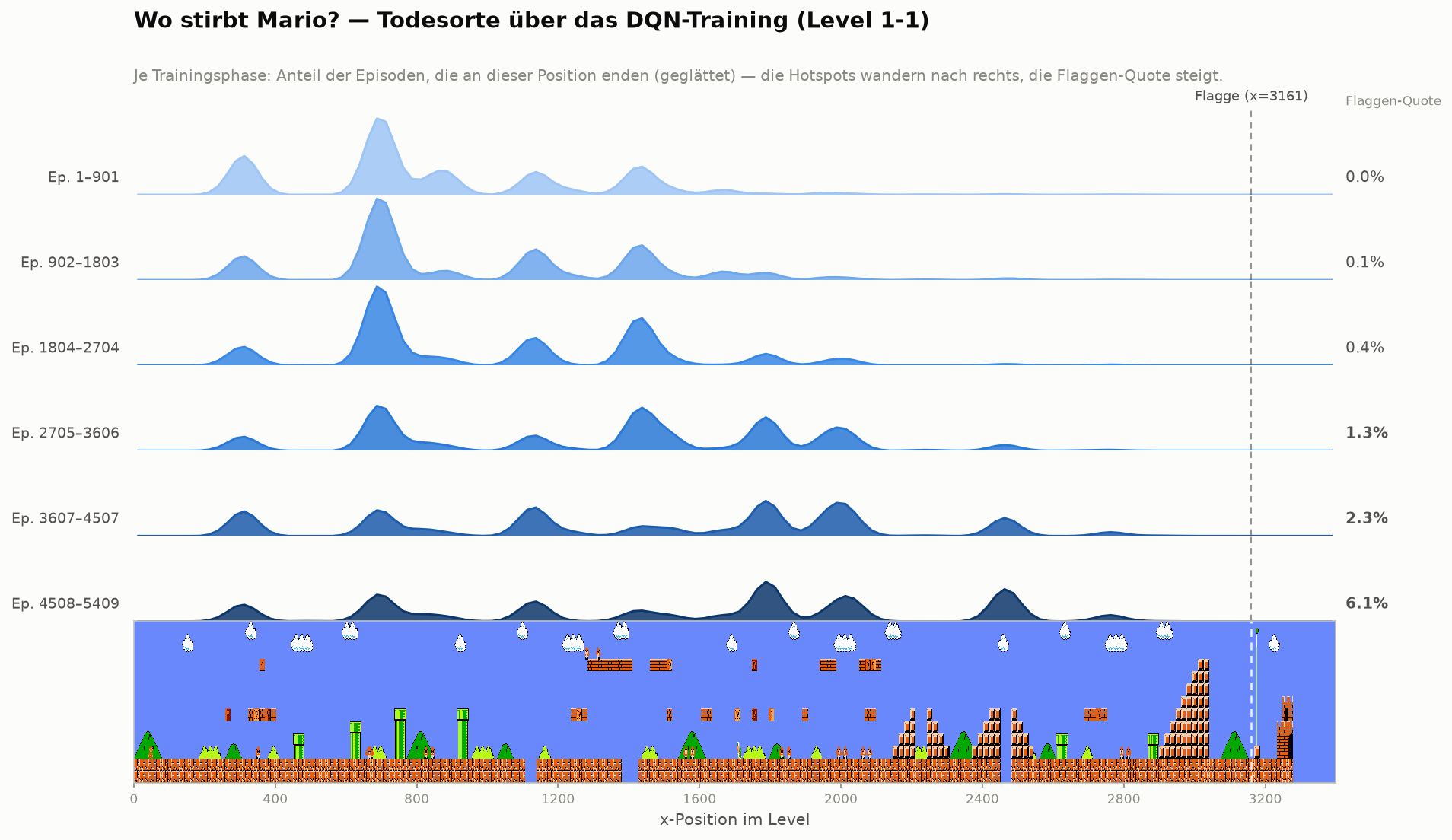
- Death heatmaps: death positions from 5,409 training episodes drawn over a level panorama – you can watch the level being “conquered” from left to right
- When the agent fails: three GIFs of the states before the fix – reward hacking (4-4), giving up in front of a gate (7-4), standing still out of safety (8-2). Each case led to a concrete fix in the code.
- Human vs. AI: record your own run and race the agent as a side-by-side GIF, on any of the 32 levels
The engineering around it
- Tests (pytest) + CI via GitHub Actions (run without emulator/GPU)
- Docker + Kubernetes: a hyperparameter sweep actually ran as four parallel K8s Jobs in a kind cluster – including the lessons behind it (a 24 GB build context, OOMKilled by the replay buffer)
- Optional Weights & Biases experiment tracking
- A Gradio demo app, deployed as a public Hugging Face Space with all 32 levels. The Space serves precomputed runs – on foreign hardware the deterministic trajectory diverges, because different BLAS rounding flips a close argmax. “Deterministically solved” holds per machine.
Why this project
You only understand RL by building and debugging replay buffers, target networks and reward design yourself once. Every level exhibited a different RL “disease” with its own remedy: instability → reward normalization, premature convergence → more entropy, hard exploration → savestate search, reward hacking → measurable reward fixes. The real lesson, though, sits in those five metric bugs: when a search finds nothing, the first question isn’t “how do I search better?” but “would I even notice a hit?”. On top of that comes the part that turns an experiment into a real project: testing it reproducibly, containerizing it, and making it showable as a browser demo.